†Lower PMF rates are available to UConn and UConn Health users due to University subsidy.
Services
PMF offers customized sample preparation and UPLC-MS/MS services for both proteomic and metabolomic platforms. Rates are customized based on the sample preparation and UPLC-MS/MS analysis types (instrumentation) required. See below for more information on our offered services, available instrumentation, and available software with corresponding FY2026 rates that are active as of January 1, 2025. All rates are subject to change. For more information on services, instrumentation, and associated rates or to request a quote for new projects, contact the Facility Director.
Rates
FY2027 rates are listed below and are active as of October 1, 2026. All rates subject to change.
Sample Preparation Fees
| Billable unit | UConn† | External academic | Industry | |
| In-gel digestion (Coomassie blue- or silver-stained)* | per band | $72 | $100 | $150 |
| In-solution tryptic digestion (<25 ug)^ | per sample | $72 | $100 | $150 |
| Non-trypsin endoproteinases | per vial | Reagent cost | Reagent cost | Reagent cost |
| Filter-Aided Sample Preparation (FASP)^ | per sample | $191 | $253 | $381 |
| S-Trap^ | per sample | $168 | $234 | $352 |
| In-vitro labeling | per sample | $92 + reagent cost | $124 + reagent cost# | $157 + reagent cost# |
| PTM enrichment | per hr | $92 + reagent cost | $124 + reagent cost# | $157 + reagent cost# |
| Offline fractionation | per sample | $88 | $129 | $193 |
| Intact protein or peptide digest clean-up | per sample | $27 | $37 | $55 |
| Custom sample prep (e.g. BCA protein quantification) | per hr | $92 + reagent cost | $124 + reagent cost | $157 + reagent cost |
| Metabolomics sample preparation consumables | per unit | reagent cost | reagent cost | reagent cost |
*includes destaining, reduction, alkylation, tryptic digestion, peptide extraction and clean-up
^includes reduction, alkylation, tryptic digestion, peptide clean-up
†Lower PMF rates are available to UConn and UConn Health users due to University subsidy.
UPLC-MS & UPLC-MS/MS Analysis Fees
| Billable rate | UConn† | External Academic | Industry | |
| Nanoflow Proteomics Applications |
||||
| Experiment set-up fee for assisted proteomics analysis# | per experiment | $92 | $124 | $157 |
| Intact protein mass measurement (by infusion) | per sample | $50 | $53 | $79 |
| timsTOF HT UPLC-MS/MS analysis | per hr | $64 | $121 | $184 |
| Orbitrap Eclipse UPLC-MS/MS analysis | per hr | $65 | $132 | $199 |
| Q Exactive-HF UPLC-MS/MS analysis | per hr | $62 | $101 | $159 |
| timsTOF Ultra 2 UPLC-MS/MS analysis | per hr | $58 | $120 | $182 |
| Hydrogen-Deuterium Exchange-MS (HDX-MS) assisted analysis∅ | per hr | $69 | $137 | $214 |
| Hydrogen-Deuterium Exchange-MS (HDX-MS), trained user | per hr | $55 | TBA | TBA |
| Microflow Metabolomics Applications | ||||
| Experiment set-up fee for user-operated metabolomics analysis# | per reservation | $46 | $62 | $78 |
| Experiment set-up fee for assisted metabolomics analysis# | per experiment | $92 | $124 | $157 |
| timsTOF HT UPLC-MS/MS assisted analysis∅ | per hr | $60 | $121 | $184 |
| Q Exactive HF UPLC-MS/MS assisted analysis∅ | per hr | $61 | $120 | $183 |
| Synapt G2-Si UPLC-MS/MS user-operation‡ | per hr | $22 | $71 | $106 |
| Synapt G2-Si UPLC-MS/MS assisted analysis∅ | per hr | $46 | $99 | $162 |
| Xevo G2-XS UPLC-MS/MS User-Operation‡ | per hr | $17 | $53 | $79 |
| Xevo G2-XS UPLC-MS/MS assisted analysis∅ | per hr | $40 | $72 | $97 |
‡User-operation requires previous instrument training performed by PMF Faculty
∅Assistance/full-service provided by PMF Faculty only
#Includes instrument calibration(s), LC solvent changes, column cleaning, QC and initial solvent blank injections. For assisted runs, this includes sample resuspension, quantification, transfer to injection vials, and establishment of sample queue(s).
†Lower PMF rates are available to UConn and UConn Health users due to University subsidy.
Training Fees
| Billable rate | UConn† | External Academic | Industry | |
| Hands-on instrumentation and/or software training | per hr | $92 | $124 | $157 |
†Lower PMF rates are available to UConn and UConn Health users due to University subsidy.
Data Analysis Fees
| Billable rate | UConn† | External Academic | Industry | |
| Manual data analysis (e.g. PTM localization, custom quantitation) | per hr | $92 | $124 | $157 |
| Standard informatics-based processing of raw data | per experiment | included in run-time fees | included in run-time fees | included in run-time fees |
Instrumentation
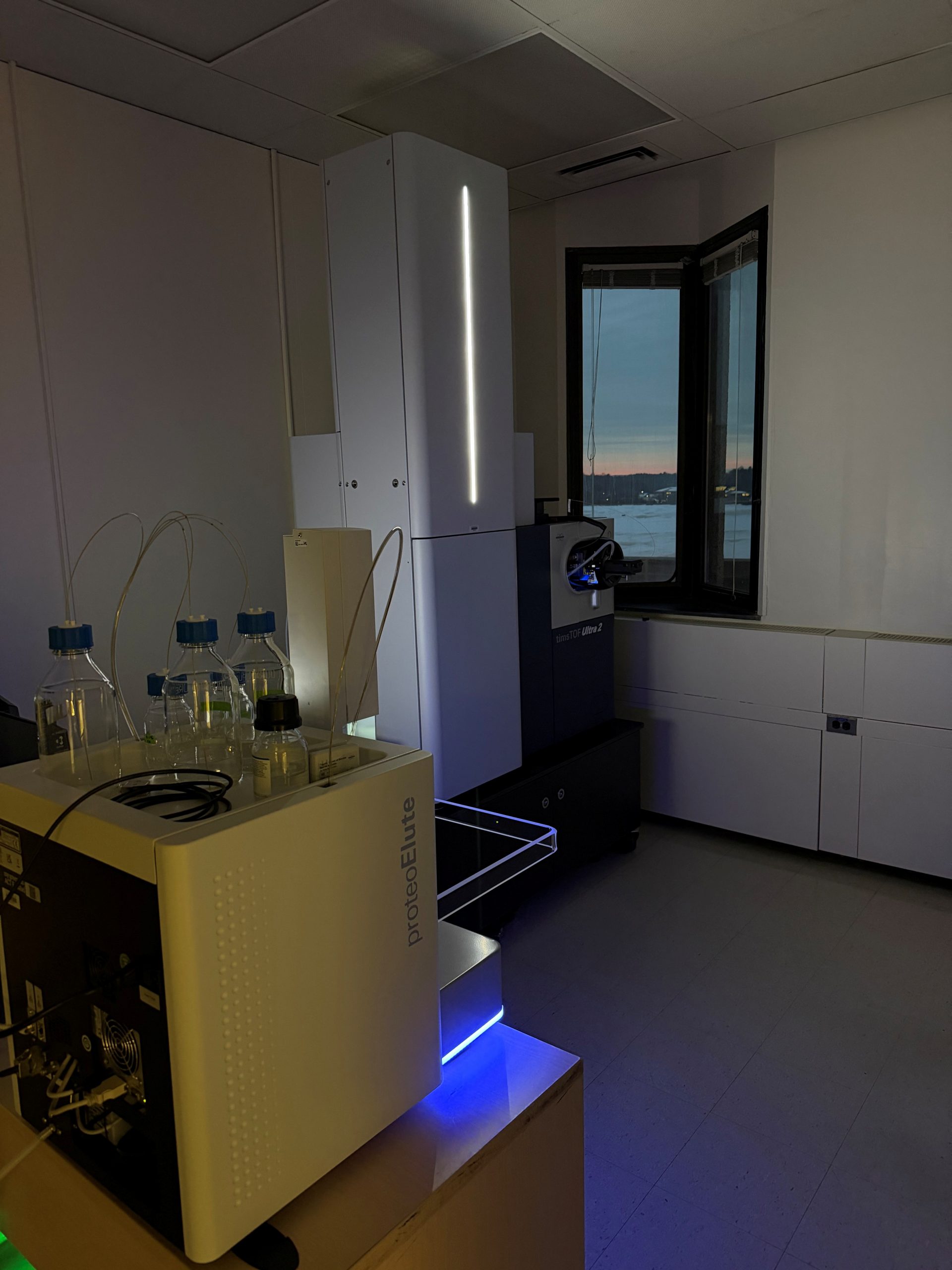
Bruker timsTOF Ultra 2 Mass Spectrometer (Farmington)
- Provides unprecedented sensitivity to enable ultra-low input proteomic analysis via Parallel Accumulation with Serial Fragmentation (PASEF) technology and Trapped Ion Mobility Spectrometry (TIMS)-mediated gas phase separations of ions for increased selectivity prior to mass analysis
- Features maximum MS and MS/MS scan rates of ~300 Hz
- Capable of multiple mass spectral acquisition options that incorporate PASEF technology, including data-dependent acquisition (DDA-PASEF), data-independent acquisition (DIA-PASEF), and parallel-reaction monitoring (PRM-PASEF) modes
- Directly coupled to a Bruker ProteoElute UPLC for high resolution, reversed-phase liquid peptide separations at nanoflow rates for maximum sensitivity
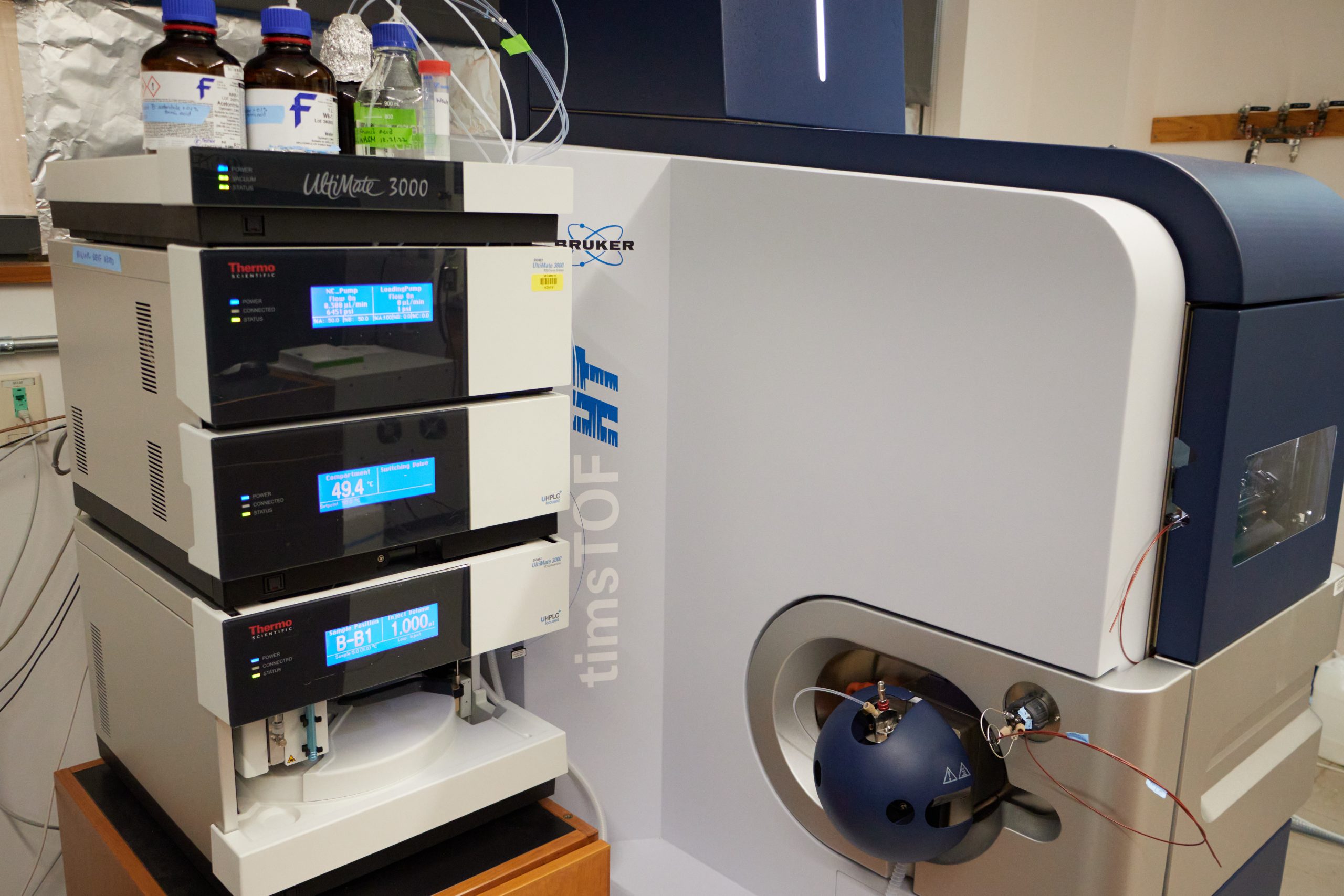
Bruker timsTOF HT Mass Spectrometer (Storrs)
- Provides unprecedented depth of proteome coverage over a wide range of input amounts via Parallel Accumulation with Serial Fragmentation (PASEF) technology and Trapped Ion Mobility Spectrometry (TIMS)-mediated gas phase separations of ions for increased selectivity prior to mass analysis
- Features maximum MS and MS/MS scan rates of ~300 Hz
- Capable of multiple mass spectral acquisition options that incorporate PASEF technology, including data-dependent acquisition (DDA-PASEF), data-independent acquisition (DIA-PASEF), and parallel-reaction monitoring (PRM-PASEF) modes
- Directly coupled to a Thermo Scientific Dionex Ultimate 3000 RSLCnano UPLC for high resolution, reversed-phase liquid peptide separations at nanoflow rates for maximum sensitivity
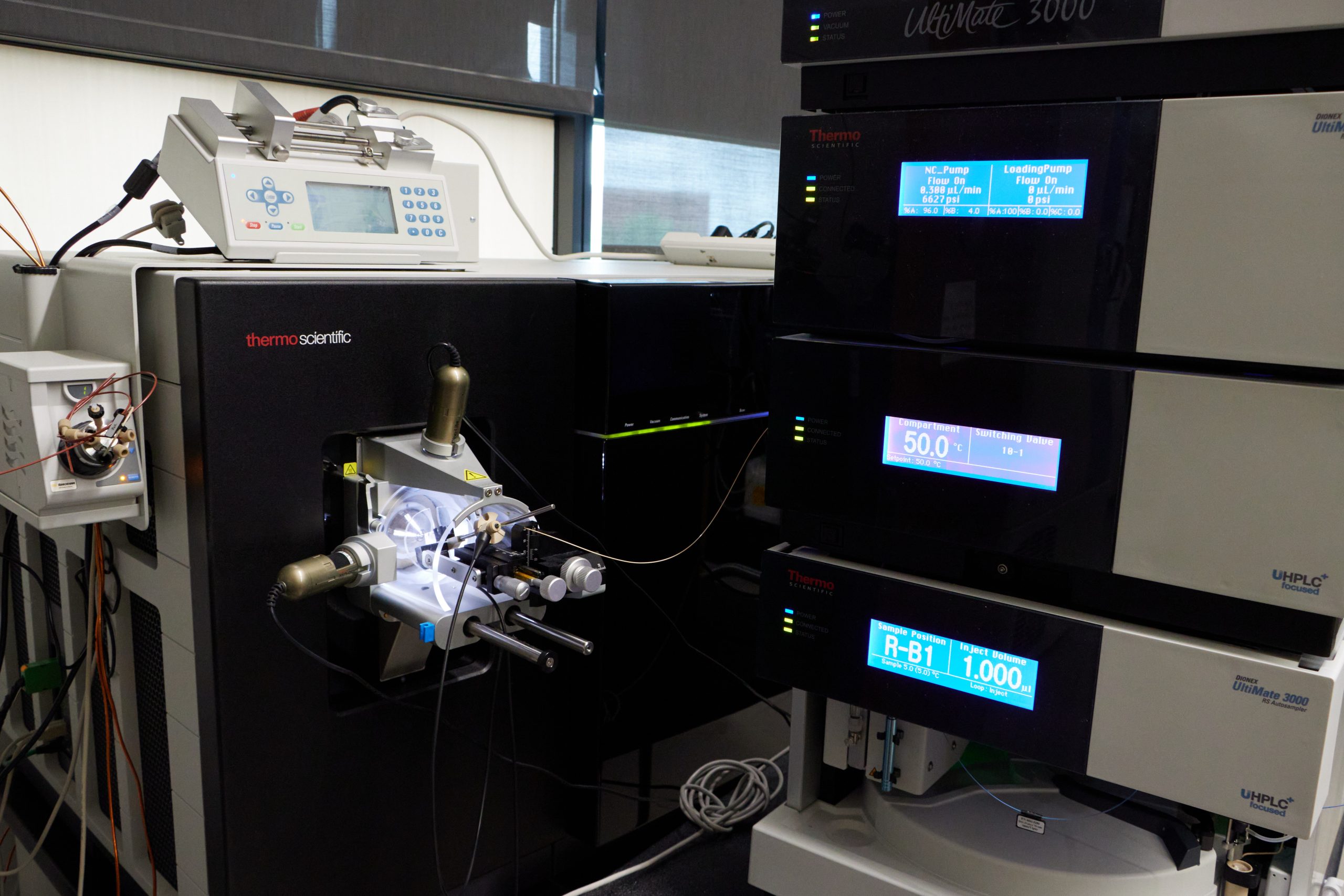
Thermo Scientific Orbitrap Eclipse Tribrid Mass Spectrometer (Storrs)
- Provides multiple mass analysis and detection modes for MS and MS/MS using an Orbitrap or dual-pressure linear ion trap
- Features multiple types of gas-phase fragmentation including collision-induced dissociation (CID), higher energy C-trap dissociation (HCD), electron transfer dissociation (ETD) plus hybrid versions of these techniques: EThcD and ETciD
- Equipped to perform Real-Time Search (RTS) and Synchronous Precursor Selection (SPS) MS3-based acquisition methods for multiplexed proteomics analyses that incorporate Thermo Scientific Tandem Mass Tags (TMT) reagents for peptide quantitation
- Capable of multiple mass spectral acquisition options including data-dependent acquisition (DDA), data-independent acquisition (DIA), and parallel-reaction monitoring (PRM) modes
- Directly coupled to a Thermo Scientific Dionex Ultimate 3000 RSLCnano UPLC for high resolution reversed-phase liquid peptide/protein separations at variable flow regimes, including nanoflow rates for maximum sensitivity
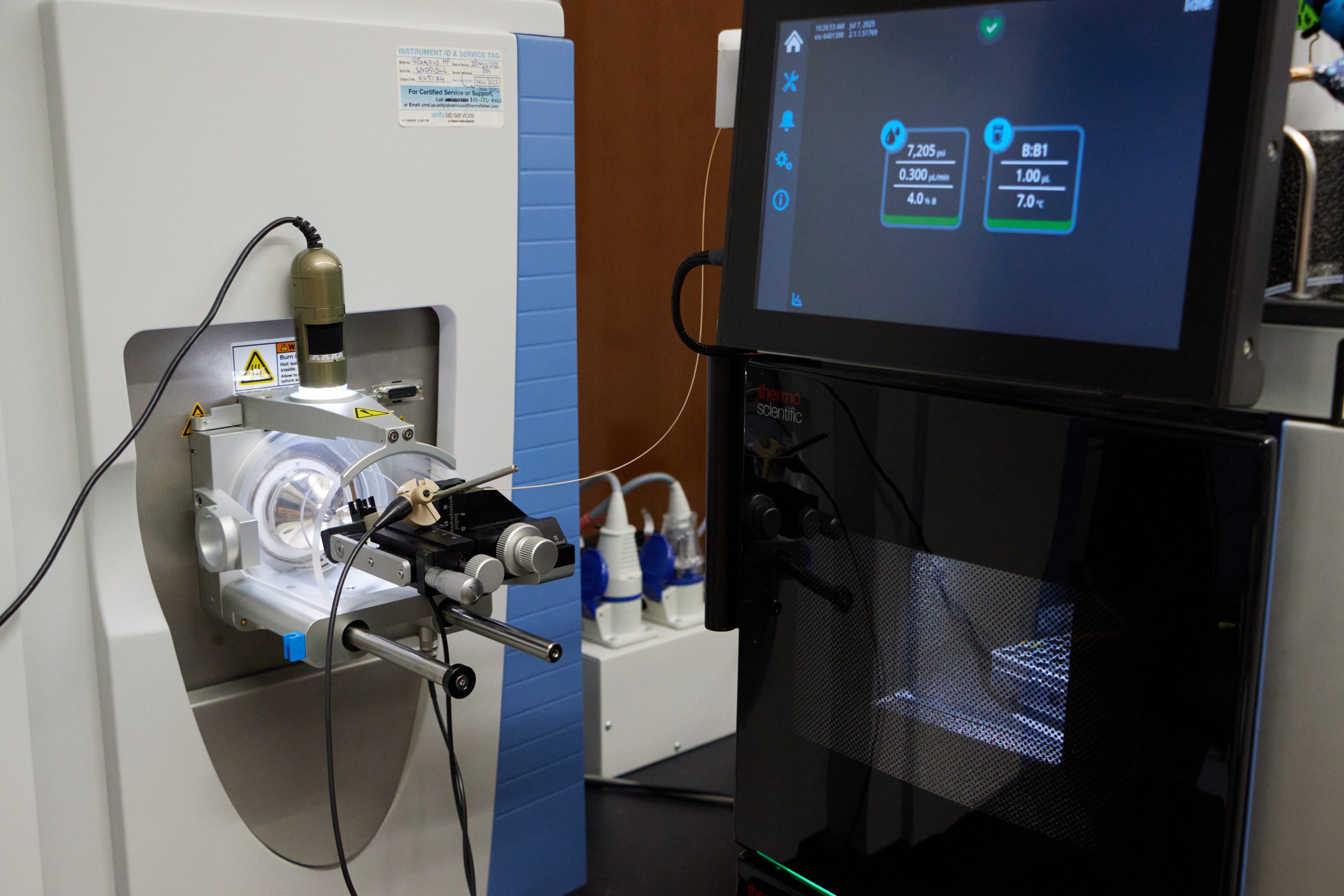
Thermo Scientific Q Exactive HF Mass Spectrometer (Storrs)
- Provides high resolution, accurate mass determinations for MS and MS/MS analysis of proteins and peptides in complex mixtures using High-Field (HF) Orbitrap technology
- Capable of multiple mass spectral acquisition options including data-dependent acquisition (DDA), data-independent acquisition (DIA), and parallel-reaction monitoring (PRM) modes
- Directly coupled to a Thermo Scientific Vanquish Neo UPLC for high resolution reversed-phase liquid peptide/protein separations
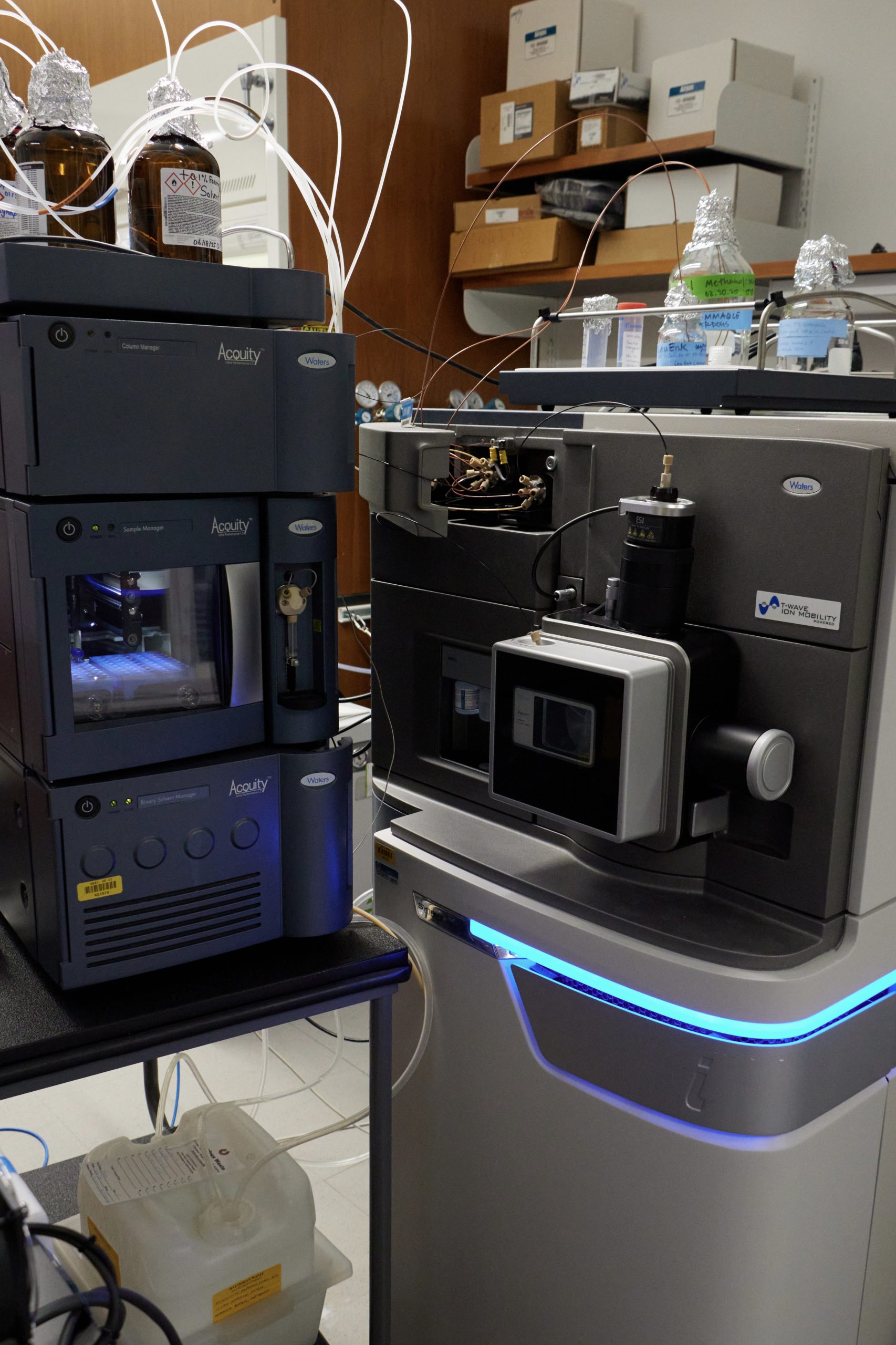
Waters Synapt G2-Si Mass Spectrometer with HDX-MS (Storrs)
- Provides high resolution, accurate mass measurements for MS and MS/MS analysis of small molecules in complex mixtures using q-TOF technology
- Capable of multiple mass spectral acquisition options including DDA and DIA modes (MSe)
- Ion mobility technology provides another dimension of separation based on collisional-cross section (analyte size and shape) when mass and retention time aren’t sufficient to separate chemically ambiguous analytes and/or isomers
- Directly coupled to a Waters Acquity UPLC for high resolution liquid-phase separations at micro-flow rates (μL/min)
- Can also be directly coupled to a Trajan robotics system with Waters nanoAcquity UPLC pumps to enable hydrogen-deuterium exchange mass spectrometry (HDX-MS), a technique that enables intact protein conformational interrogation and protein-protein or protein-ligand interaction site determination. Contact us for more information on our HDX-MS capabilities!
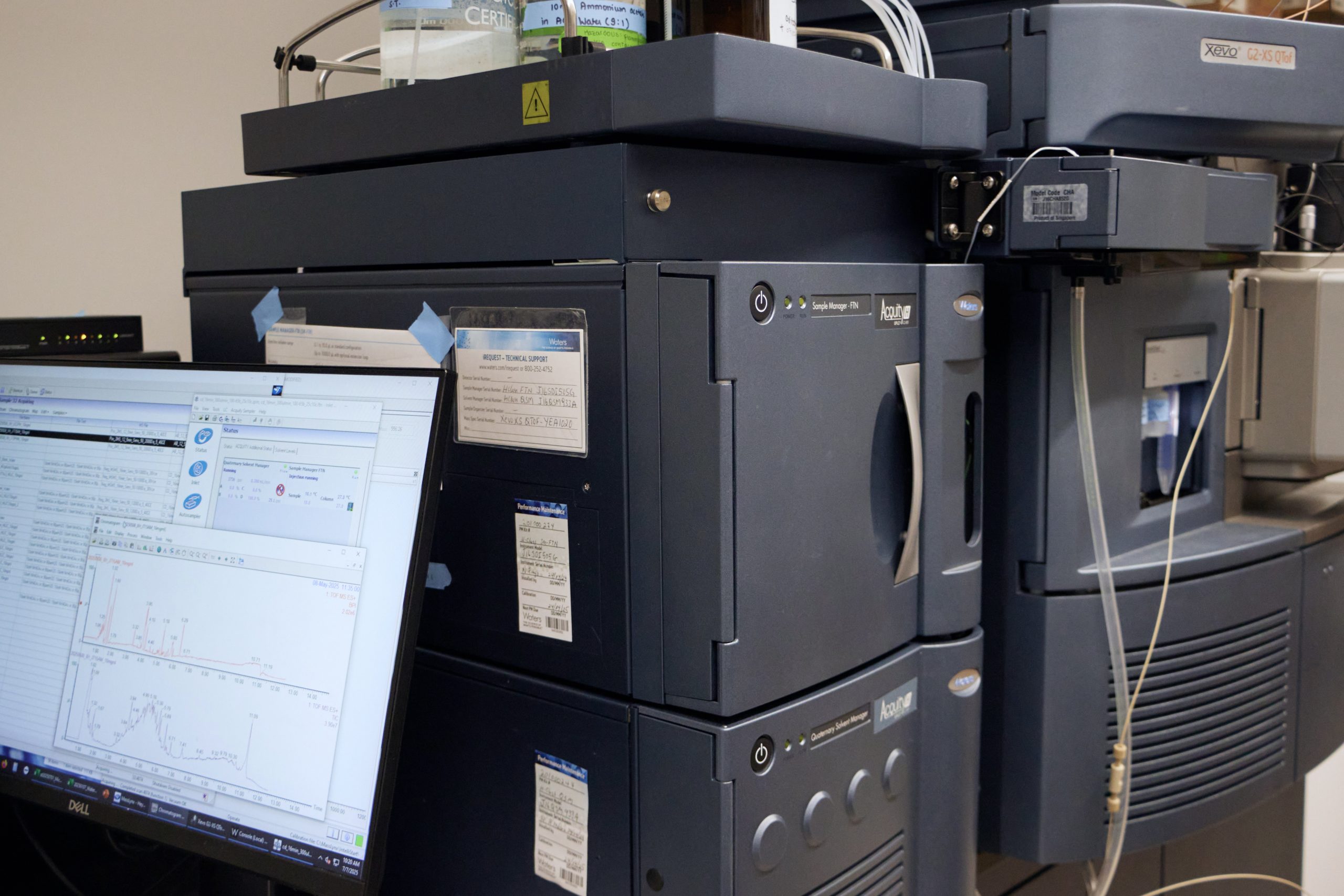
Waters Xevo G2-XS q-TOF Mass Spectrometer (Storrs)
- Provides high resolution, accurate mass measurements for MS and MS/MS analysis of small molecules in complex mixtures using q-TOF technologyCapable of multiple mass spectral acquisition options including DDA and DIA modes (MSe and SONAR)
- Directly coupled to a Waters H-Class UPLC with Quaternary Solvent Manager for complex liquid-phase separations at micro-flow rates (μL/min) and binary- to quaternary-style gradient modes
Available Software
- Proteomics: MaxQuant (Ref), Spectronaut v19+, Proteome Discoverer v2.5 with XlinkX node (Thermo Scientific), Byonic (Protein Metrics, Inc.), Scaffold 5 and Scaffold DDA (Proteome Software, Inc.), FragPipe, msDiaLogue (custom R package for analysis of DDA and DIA proteomics datasets)
- Hydrogen-deuterium Exchange MS: DynamX 3.0 & ProteinLynx Global Server (PLGS, Waters Corporation)
- Metabolomics: Metaboscape (Bruker), Progenesis QI (Nonlinear Dynamics)